How to Get to Koyasan from Osaka, Kyoto and Tokyo
Key takeaways
- The easiest route is via Nankai Railway from Osaka's Namba Station to Gokurakubashi, then the cable car up to Koyasan.
- From Kyoto or Tokyo, travellers connect to Shin-Osaka or Namba first, adding roughly 1-1.5 hours to the Osaka leg.
- A short local bus ride is needed from Koyasan's cable car station into the temple town itself; walking the whole way is not realistic with luggage.
How to Get to Koyasan: Quick Answer
The most reliable way to reach Koyasan (高野山) is by Nankai Railway from Namba Station (難波駅) in Osaka to Gokurakubashi Station (極楽橋駅), followed by a short cable car ride up the mountain. From Kyoto or Tokyo, travellers first make their way to Osaka — either Namba or Shin-Osaka — and then follow the same Nankai Railway route. There is no bullet train or direct line straight to Koyasan, so every trip involves at least one change of train in Osaka.
Koyasan sits deep in the mountains of Wakayama Prefecture and is the center of Shingon Buddhism, home to Okunoin cemetery and a cluster of working temples. Because of its remote, elevated location, getting there always involves a combination of train, cable car, and a final local bus ride.
Starting Point: Osaka (Namba Station)
For most independent travellers, the journey begins at Namba Station in Osaka, where the Nankai Koya Line has its own platforms separate from the Osaka Metro Namba station.
Basic steps:
- At Namba Station, find the Nankai Railway ticket gates and platforms for the Koya Line (高野線).
- Take a Nankai limited express or rapid express train bound for Gokurakubashi. Some services require a reserved-seat limited express ticket in addition to the base fare; others are ordinary rapid/local trains included in the basic fare.
- Ride to the end of the line at Gokurakubashi Station — this takes roughly 1.5 hours depending on the train type.
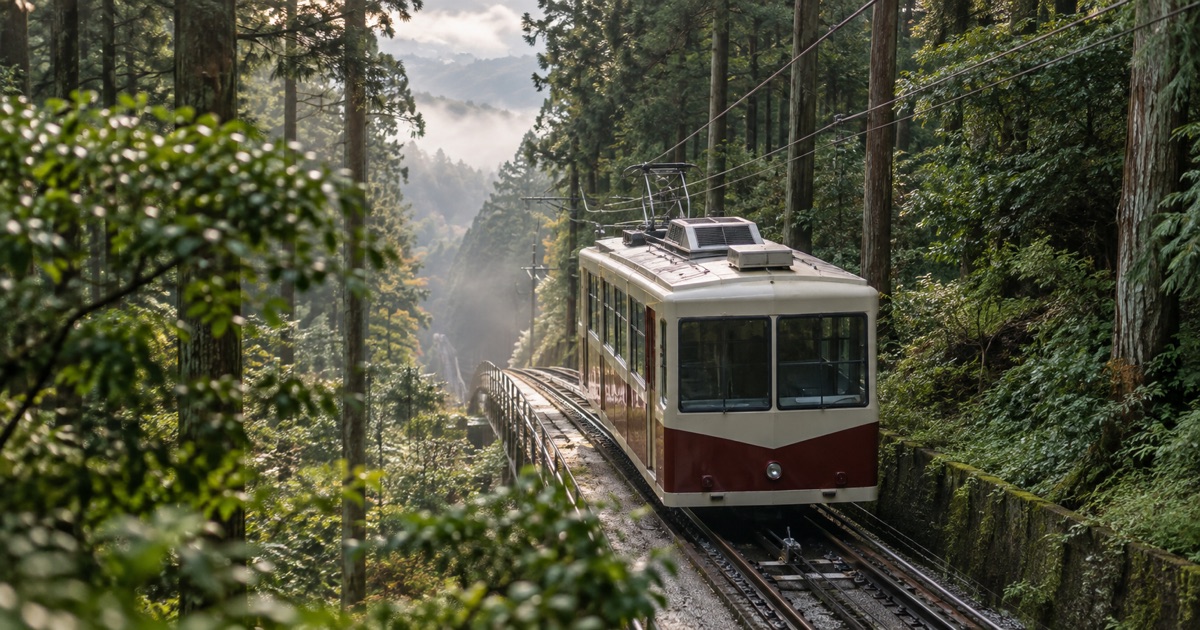
- At Gokurakubashi, transfer directly to the Koyasan cable car (ropeway), which climbs the mountainside in about 5 minutes.
- At the top cable car station, board a Nankai Rinkan bus into the town center of Koyasan, since the main temple area is a few kilometers from the cable car station and not realistically walkable with luggage.
Many travellers buy a discount set ticket from Nankai Railway that bundles the train fare, limited express surcharge, cable car, and a bus pass for getting around Koyasan once you arrive. These tickets are sold at Nankai's travel counters in Namba and sometimes at Kansai Airport, and the exact price and inclusions can change, so check current details before you go.
We are working to carry Japanese craft and everyday culture beyond Japan, by building Japan Towns with local partners.
Read the Japan Town plan →Starting Point: Kyoto
There is no direct train from Kyoto to Koyasan, so the standard approach is:
- From Kyoto Station, take a JR or Hankyu/Keihan connection toward Osaka (commonly via JR Kyoto Line) to reach Shin-Osaka or Osaka Station, then transfer to the Midosuji subway line or JR loop line to reach Namba.
- From Namba, follow the same Nankai Railway route described above.
Total travel time from Kyoto Station to Koyasan is typically in the range of 3 to 3.5 hours including transfers, so it's realistic as a long day trip but more comfortable as an overnight stay if you want time to see Okunoin in the early morning or evening, when it's often considered most atmospheric.
Starting Point: Tokyo
From Tokyo, there is no single-seat journey to Koyasan, so travellers first head to Osaka by Shinkansen:
- Take the Tokaido Shinkansen from Tokyo Station or Shinagawa Station to Shin-Osaka Station, a journey of roughly 2.5 hours. You can check current Shinkansen schedules and services on the JR Central website.
- From Shin-Osaka, transfer to the Midosuji subway line and ride to Namba Station (around 20-30 minutes).
- At Namba, switch to the Nankai Koya Line and follow the same steps toward Gokurakubashi, the cable car, and the local bus into town.
Because of the distance, Koyasan is not a realistic single-day round trip from Tokyo. Most visitors treat it as a multi-day itinerary, often combining it with Osaka, Kyoto, or the wider Kansai region, and staying at least one night near the temple town.
What to Bring and Common Mistakes
- IC cards work partway, but not all the way. Suica, ICOCA, and similar IC cards can be used on most Nankai Railway trains and city subways, but double-check whether your planned limited express service requires a separate paper reserved-seat ticket, which usually cannot be bought with an IC card alone at the gate.
- Pack light. The transfer sequence (train → cable car → bus) involves several short walks with stairs, so oversized suitcases can be awkward, especially during the cable car boarding.
- Mountain weather differs from the cities. Koyasan sits at a significant elevation and is noticeably cooler than Osaka or Kyoto, particularly in the early morning and evening, so bring a layer even in warmer months.
- Cash still matters. While IC cards are widely accepted on trains and buses, some smaller shops, temple lodgings, and vending points in Koyasan may prefer cash, so carry some yen.
- Don't assume every Nankai train goes all the way. Some Koya Line trains terminate partway and require a same-platform transfer to continue toward Gokurakubashi — watch the signage or ask station staff if unsure.
- Check the last cable car and bus times before heading up. Services to and from Koyasan run less frequently than city trains, and the last connections of the day can be earlier than visitors expect, so plan your return with some buffer.
Planning Your Visit
Because schedules, fares, and discount ticket details are revised from time to time, it's worth checking official sources shortly before your trip rather than relying on older information. The Japan National Tourism Organization site is a good general starting point for access information and seasonal travel advice, and Nankai Railway's own English pages list current routes between Namba and Koyasan.
If you're combining Koyasan with a wider Kansai itinerary, it pairs naturally with an Osaka base, since Namba functions as the clear gateway station. Travellers coming from Kyoto or Tokyo should simply build in extra transfer time at Osaka and treat Koyasan as a dedicated overnight or long day trip rather than a quick add-on.
FAQ
- Q. Can I get to Koyasan directly from Kyoto or Tokyo without going through Osaka?
- A. Not really — there is no direct line, so most travellers route through Osaka's Namba Station (or Shin-Osaka for the Shinkansen) and then take the Nankai Railway toward Gokurakubashi.
- Q. Is the Koyasan cable car (ropeway) included in any rail pass?
- A. Nankai Railway sells its own Koyasan discount tickets covering train, cable car and local bus; check the [Nankai Railway](https://www.howto-osaka.com/en/) or regional tourism sites for current details, as coverage and prices can change.
- Q. How long does the whole trip take from central Osaka?
- A. Roughly 2 to 2.5 hours door to door from Namba Station, including the cable car and local bus into town, though timetables vary by connection.
Cite or share this article
Copy the link below. If you quote this article, please link to this page as the source.