How to Get to Koyasan from Kyoto: Step-by-Step Guide
Key takeaways
- Reach Koyasan from Kyoto Station in roughly 2.5 to 3 hours using train, subway, and cable car connections via Osaka.
- Transfer at Shin-Osaka or Osaka Station, take the Osaka Loop Line or subway to Namba, then board the Nankai Koya Line.
- A dedicated bus from Koyasan Cable Car Station takes visitors directly into the mountaintop temple village.
To get to Koyasan (高野山, Mount Koya) from Kyoto Station (京都駅), take a train south into Osaka, ride the subway or loop line to Namba Station (難波駅), and board the private Nankai Electric Railway to Gokurakubashi Station (極楽橋駅). From Gokurakubashi, board the Koyasan Cable Car up the mountain and finish the journey into town via a local connecting bus, with total travel time averaging roughly 2.5 to 3 hours each way.
Mount Koya is the world headquarters of the Shingon sect of Japanese Buddhism, nestled in a high mountain basin in Wakayama Prefecture. Because Koyasan sits deep in the forested peaks south of Osaka, navigating from historic Kyoto requires transitioning between different rail operators. This step-by-step guide explains the complete route, transfer hubs, ticketing, and key logistics for independent travellers.
Understanding the Journey from Kyoto to Koyasan
The route from Kyoto to Koyasan involves four distinct segments:
- Kyoto Station to central Osaka (JR or private line)
- Osaka transit hub to Nankai Namba Station (Osaka Metro or JR)
- Nankai Namba Station to Gokurakubashi Station (Nankai Electric Railway)
- Gokurakubashi Station to Koyasan town centre (Cable car and bus)
Because Koyasan is served exclusively by the private Nankai Railway and its affiliated bus network, no single train runs directly from Kyoto into the mountain valley. Careful transfer planning makes the journey straightforward, even for first-time visitors who do not read or speak Japanese.
Step 1: Kyoto to Namba Station
The first phase of the trip requires travelling from Kyoto Station to Namba (難波), the primary departure terminal for trains heading south to Koyasan.
Option A: The Standard JR Route (Best for JR Pass Holders)
From Kyoto Station, board a JR Special Rapid train (Shin-kaisoku, 新快速) bound for Osaka Station (大阪駅). The ride takes roughly 30 minutes.
At Osaka Station, make your way to the Osaka Loop Line (Kanjo-sen, 大阪環状線) or transfer to the underground Osaka Metro Midosuji Line (御堂筋線) at Umeda Station (梅田駅). Taking the Midosuji Line south directly to Namba Station takes about 9 minutes. If using the JR Loop Line, take a train to Shin-Imamiya Station (新今宮駅), where you can cross straight over to the Nankai Line platforms without visiting Namba first.
For schedules and standard rail routes across the region, refer to JR West.
Option B: The Shinkansen Route
Travellers holding certain JR passes may opt to take the Tokaido Shinkansen from Kyoto Station to Shin-Osaka Station (新大阪駅), which takes roughly 13 to 15 minutes. From Shin-Osaka, transfer directly to the Osaka Metro Midosuji Line and ride south to Namba Station (around 15 minutes). While the bullet train saves a few minutes of track time, the additional transfer at Shin-Osaka often balances out the overall duration compared to the direct JR Special Rapid.

We are working to carry Japanese craft and everyday culture beyond Japan, by building Japan Towns with local partners.
Read the Japan Town plan →Step 2: Nankai Railway from Namba to Gokurakubashi
Nankai Namba Station (南海難波駅) is a major terminus located in southern Osaka. Follow the bright overhead signs marked "Nankai Line" inside the Namba underground complex to reach the third-floor ticketing concourse.
From Namba, two types of trains run along the Nankai Koya Line down to Gokurakubashi Station at the base of the mountain:
1. Limited Express Koya (特急こうや)
The Limited Express "Koya" is the fastest and most comfortable service. It travels directly between Namba and Gokurakubashi without requiring train transfers along the line. The ride takes roughly 80 to 90 minutes.
Because this is a reserved-seat express train, passengers must purchase a standard transit fare plus a limited express seat ticket. Limited Express Koya trains run on a limited schedule, often only a few times per day on weekdays, with slightly more frequent departures on weekends and holidays. Timetables shift seasonally, so verify the schedule before departing.
2. Express or Rapid Express Trains (急行 / 快速急行)
If your schedule does not line up with a Limited Express Koya departure, board a Nankai Koya Line Express (Kyuko) bound for Hashimoto Station (橋本駅).
At Hashimoto Station, walk across the platform to transfer to a connecting local or rapid train running the remaining steep mountain segment between Hashimoto and Gokurakubashi. This standard commuter configuration takes roughly 100 to 110 minutes from Namba. It requires only standard train fare (no express surcharge) and seats cannot be reserved in advance.
Step 3: Gokurakubashi to Koyasan via Cable Car
Gokurakubashi Station is the end of the traditional railway line. The name translates to "Bridge of Paradise," marking the boundary where modern railways give way to the sacred mountain ascent.
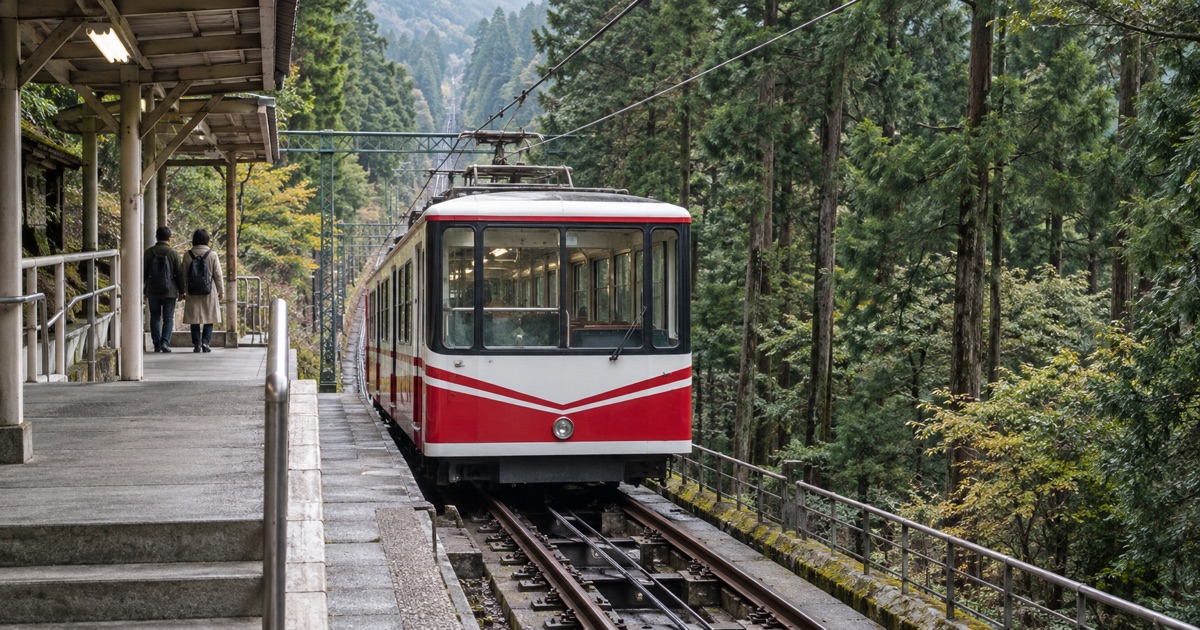
At Gokurakubashi, follow the station signs directly onto the Koyasan Cable Car (Nankai Koyasan Cable, 高野山ケーブル). The transfer is entirely enclosed within the station facility and designed for seamless connections between arriving trains and waiting cable cars.
The cable car climbs roughly 328 vertical metres up a steep incline in approximately 5 minutes, delivering passengers to Koyasan Station (高野山駅).
Step 4: Koyasan Station to Town Centre by Bus
Upon arriving at Koyasan Station, you have reached the mountain plateau, but you are not yet inside the historical town.
Important Notice: Pedestrians are strictly prohibited from walking along the narrow mountain road connecting Koyasan Station to the town centre due to vehicular traffic and the absence of sidewalks. All visitors must take the bus or a local taxi.
Directly outside the station exit, you will find bus stops for the Nankai Rinkan Bus (南海りんかんバス). Digital display boards show English and Japanese destinations.
- To Okunoin Cemetery (奥之院): Board the bus bound for Okunoin-mae (奥の院前) or Ichinohashi-guchi (一の橋口).
- To Central Temples (Danjo Garan and Kongobuji): Board the bus bound for Senjuinbashi (千手院橋), the central crossroads of the village.
The bus ride into the town centre takes roughly 10 to 15 minutes depending on your stop.
Tickets, Passes, and Fares
Because this route spans multiple transit agencies, ticketing requires attention:
- IC Cards (ICOCA, Suica, Pasmo): Major Japanese IC cards work seamlessly on JR trains, the Osaka Metro, Nankai Railway regular trains, the Koyasan Cable Car, and the Nankai Rinkan Bus network. Ensure your card balance is loaded with at least 3,500 to 4,000 yen for the round trip.
- Koyasan World Heritage Ticket: Sold by Nankai Electric Railway, this pass covers round-trip transit from Namba to Koyasan, unlimited rides on Nankai Rinkan buses within Koyasan, and discount admissions to select cultural sites. It is valid for two consecutive days.
- Japan Rail Pass: The JR Pass covers only the Kyoto-to-Osaka section (JR Special Rapid or Shinkansen between Kyoto and Shin-Osaka). It cannot be used on the Osaka Metro, Nankai Railway, the cable car, or Koyasan buses.
For general rail planning and national transit advisories, consult the Japan National Tourism Organization.
Packing and Preparation for Koyasan
Because Koyasan sits approximately 800 metres above sea level, conditions differ markedly from Kyoto and Osaka:
- Temperature Differences: The mountain summit is consistently 5 to 10 degrees Celsius cooler than low-lying Kyoto. Even in summer, evenings are brisk. In autumn and spring, pack thermal base layers and a windproof jacket. In winter, snow and icy paths are standard.
- Footwear: Koyasan involves extensive walking on stone-paved paths, cedar forest trails, and wooden temple verandas. Wear comfortable, supportive walking shoes that can be easily slipped off and on when entering temple halls.
- Cash: While modern digital payments and IC cards work for primary transport, small shops, tea houses, temple donation boxes, and candle offerings throughout Okunoin operate strictly with Japanese yen cash. Carry sufficient coins and small bills.
- Timing: Temples and ticket offices generally conclude admissions in the late afternoon. Starting from Kyoto no later than 7:00 AM or 8:00 AM ensures adequate time to explore the Danjo Garan (壇上伽藍), Kongobuji (金剛峯寺), and the sprawling Okunoin cemetery before return transit winds down.
FAQ
- Q. Does the Japan Rail (JR) Pass cover the entire trip to Koyasan?
- A. No, the JR Pass covers travel only between Kyoto and Osaka; the Nankai Electric Railway and Koyasan local buses require separate tickets.
- Q. How long does a day trip from Kyoto to Koyasan take?
- A. One-way transit takes roughly 2.5 to 3 hours, meaning travellers should allocate 5 to 6 hours for round-trip travel alone.
- Q. Can you walk from Koyasan Station into the town centre?
- A. Walking along the road from Koyasan Station is strictly prohibited for pedestrians; travellers must take the local Nankai Rinkan Bus.
Cite or share this article
Copy the link below. If you quote this article, please link to this page as the source.