Tokyo Skytree: How Long Can You Stay at the Top?
Key takeaways
- Once inside the observation decks, there is no official time limit; you can stay as long as you want until closing.
- Most visitors spend roughly 1.5 to 2 hours exploring both the Tembo Deck (350m) and Tembo Galleria (450m).
- Tickets require timed entry for the elevator ride up, but leaving the decks is entirely flexible and self-paced.
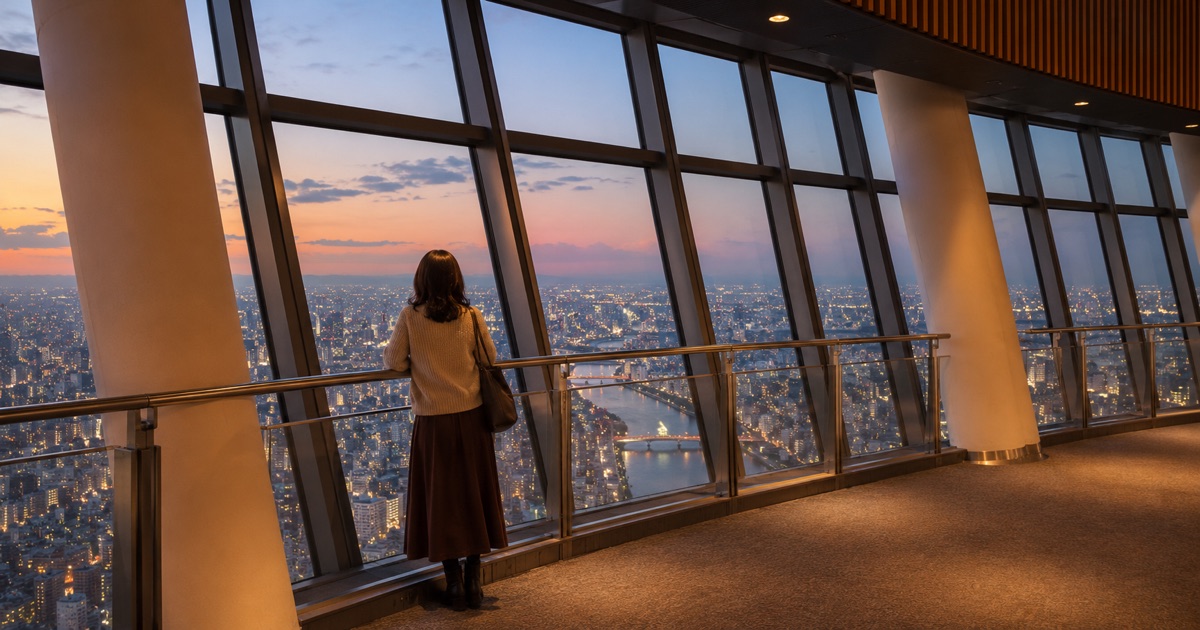
There is no official time limit on how long you can stay at Tokyo Skytree (東京スカイツリー) once you arrive on the observation decks. You can remain at the top for as long as you like until the tower closes for the night, making it easy to watch the transition from late-afternoon daylight to sunset and city nightscapes.
While entrance tickets require an assigned arrival window to control elevator queues, exit times are completely unregulated. Most first-time visitors spend between 90 minutes and two hours exploring the viewing platforms, though factoring in the massive shopping complex at the base easily turns the trip into a satisfying half-day excursion.
How the Ticket and Entry Timing Works
Tokyo Skytree features two distinct observation levels: the Tembo Deck (天望デッキ) at 350 meters above ground level and the Tembo Galleria (天望回廊) at 450 meters.
When purchasing advance tickets or booking a designated arrival slot online, you select a specific 30-minute or 60-minute entry window. This reservation determines when you can line up for the high-speed shuttle elevator on the 4th floor.
Once your ticket is scanned and you step out into the Tembo Deck, your time is your own:
- No exit checks: Staff will not monitor your stay or ask you to move toward the exit elevators after a set number of minutes.
- Single-entry restriction: Re-entry is not permitted. Once you ride the elevator down to the 5th-floor exit concourse, your ticket is no longer valid.
- Combined deck flow: If your ticket includes the higher Tembo Galleria (450m), you take a second dedicated elevator up from the 350m level. You can linger on the 450m spiral ramp and then return to the 350m deck at your own pace before heading to the ground level.
Operating hours and ticket desk schedules can change depending on seasonal factors, public holidays, and severe weather. Always verify the latest admission terms and ticket tiers on the official Tokyo Skytree website before booking.
How Much Time to Budget: Realistic Timelines
How long you choose to stay depends on your pace, photography goals, and whether you plan to eat or shop at elevation.
Quick Whirlwind Visit (Around 60 to 75 Minutes)
If you only purchase access to the Tembo Deck (350m), a brisk lap around the panoramic glass perimeter takes roughly 45 minutes. Add 15 to 30 minutes for elevator lines and a brief stop at the famous glass-floor section on Floor 340, and you can comfortably finish within an hour and fifteen minutes.
Standard Comprehensive Visit (Around 90 to 120 Minutes)
This is the recommended pace for most international travelers. It allows roughly 45 minutes on the 350-meter deck, 30 to 40 minutes walking the sloping tube-like corridor of the 450-meter Tembo Galleria, and extra time to wait for unobstructed photo opportunities or order a beverage at the cafe.
The Sunset-to-Night Visit (Around 2 to 3 Hours)
Many travelers deliberately enter approximately one hour before sunset. This strategy lets you view the sprawling Kanto plain and Mount Fuji (富士山) in daylight, catch the sun setting over the Shinjuku skyline, and watch Tokyo illuminate after dark. Because this is the most popular time of day, plan for larger crowds and slightly longer elevator waits.
We are working to carry Japanese craft and everyday culture beyond Japan, by building Japan Towns with local partners.
Read the Japan Town plan →What to See Across the Observation Levels
The tower interior is divided across multiple levels, each offering different perspectives and amenities.
Tembo Deck (Floors 340, 345, and 350)
The elevator delivers you first to Floor 350. Here, massive five-meter-high glass panels offer unbroken 360-degree views across Tokyo, Sumida River (隅田川), and neighboring prefectures on clear days.
- Floor 350: Main viewing windows, information counter, and a cafe serving light snacks and drinks.
- Floor 345: Official Skytree gift shop carrying exclusive merchandise and high-altitude dining.
- Floor 340: The vertigo-inducing tempered glass floor section, where you can look straight down beneath your feet, along with a second cafe.
Tembo Galleria (Floors 445 and 450)
A separate glass-walled elevator whisks you from Floor 350 to Floor 445. From here, you walk up a gently sloping, spiral glass tube that wraps around the tower’s exterior structure, ending at "Sorakara Point" on Floor 450—the highest accessible visitor vantage point at 451.2 meters.
Getting to Tokyo Skytree by Train
Tokyo Skytree sits east of central Tokyo in Sumida Ward. It is directly connected to two major train stations, making transit straightforward even without reading Japanese.
Route 1: From Tokyo Station (Around 25 to 30 Minutes)
- At Tokyo Station (東京駅), board the JR Yamanote Line (山手線) or JR Keihin-Tohoku Line to Ueno Station (上野駅).
- Transfer at Ueno to the Tokyo Metro Ginza Line (銀座線) heading toward Asakusa.
- At Asakusa Station (浅草駅), switch to the Tobu Skytree Line (東武スカイツリーライン) and ride one stop to Tokyo Skytree Station (とうきょうスカイツリー駅).
Alternative: Walk roughly 15 to 20 minutes across the Sumida River from Asakusa directly to Skytree to take in local street views.
Route 2: From Shinjuku Station (Around 35 Minutes)
- At Shinjuku Station (新宿駅), take the Toei Shinjuku Subway Line (都営新宿線) eastbound to Bakuro-yokoyama Station (馬喰横山駅).
- Walk through the underground concourse to connected Higashi-nihombashi Station (東日本橋駅).
- Board the Toei Asakusa Line (都営浅草線) directly to Oshiage (Skytree-mae) Station (押上〈スカイツリー前〉駅).
Route 3: From Shinagawa or Haneda Airport
The Toei Asakusa Line runs through-train operations with the Keikyu Main Line, offering direct services without transfers to Oshiage (Skytree-mae) Station. If carrying large luggage, check station maps for elevator exits, as these deep subway stations feature long staircases.
Common Mistakes and Ground-Level Tips
- Not checking the visibility forecast: If heavy rain, low cloud cover, or thick fog rolls in, visibility drops to zero, and the decks will look straight into a white wall of mist. Monitor the tower’s live camera feeds before paying admission.
- Underestimating Tokyo Solamachi (東京ソラマチ): The sprawling commercial complex directly beneath the tower houses more than 300 shops, food halls, a planetarium, and the Sumida Aquarium. Budget an extra 2 to 3 hours if you plan to shop for souvenirs or dine here.
- Forgetting your passport: International visitors purchasing discount vouchers or picking up physical tickets from web reservations must present original passports at the 4th-floor counter.
- Baggage and drone restrictions: Large suitcases are not permitted on the observation decks. Coin lockers are available on the 1st and 4th floors of the complex. Recreational drone flights are strictly prohibited around Tokyo Skytree and surrounding parks under Japanese aviation laws.
- Skipping the combined Asakusa itinerary: Because Tokyo Skytree is just across the river from historic Asakusa, pairing Senso-ji Temple (浅草寺) in the morning with an afternoon visit to Skytree creates a seamless, efficient day trip itinerary.
For broader route planning, rail pass validity, and travel alerts across the capital, consult the official Japan National Tourism Organization portal.
FAQ
- Q. Is there a time limit once you reach the Tokyo Skytree decks?
- A. No, there is no time limit after clearing the ticket gates. You are free to stay until the observation decks close for the evening.
- Q. Can you re-enter the observation decks if you leave?
- A. No, general admission tickets do not allow re-entry. Once you take the descending elevator down to the lower floors, your visit ends.
- Q. How long does a typical visit to Tokyo Skytree take?
- A. Expect to spend around 90 minutes to 2 hours on the viewing decks, plus an extra hour or two if browsing Tokyo Solamachi mall.
Cite or share this article
Copy the link below. If you quote this article, please link to this page as the source.