Nakasendo Trail Itinerary: Magome to Tsumago Day Trip
Key takeaways
- The 8 km Magome to Tsumago section takes about 2.5 to 3.5 hours of moderate walking over well-marked cobblestones.
- Nagoya Station serves as the most efficient transit hub to access the Kiso Valley trailheads by JR Limited Express train.
- Luggage forwarding services operating between tourist information centers allow you to hike hands-free between post towns.
A one-day Nakasendo trail itinerary focusing on the historic Magome to Tsumago section offers the most rewarding self-guided walk along this ancient highway. By taking early trains via Nagoya to Nakatsugawa Station, you can complete the picturesque eight-kilometer (five-mile) trail in under four hours and return to major cities by evening.
The Nakasendo was one of five major overland routes established during the Edo period (1603–1867) to connect Edo (modern-day Tokyo) with Kyoto. While much of the original road has been covered by modern highways and railways, the section through the mountainous Kiso Valley (木曽路, Kisoji) in Nagano and Gifu prefectures retains its rural atmosphere, cedar forests, and carefully preserved post towns (shukuba).
Route Overview: Magome to Tsumago
Walking from Magome (馬籠) to Tsumago (妻籠) is the standard recommendation for first-time visitors. Magome sits around 600 meters above sea level, while Tsumago sits around 430 meters. By walking north from Magome, you face a roughly two-kilometer climb to Magome Pass (馬籠峠, Magome-toge) at roughly 790 meters, followed by a longer, gentler downhill stretch through forests and farming hamlets into Tsumago.
- Total Distance: Approximately 8 kilometers (5 miles)
- Walking Time: Roughly 2.5 to 3.5 hours at a leisurely pace
- Trail Surface: Cobblestones, gravel trails, packed dirt, and short stretches of paved rural road
- Difficulty: Moderate; suitable for anyone with basic fitness, though cobblestones can be slick when wet
You can reverse the route and walk from Tsumago to Magome, but expect a longer, sustained uphill climb from the valley floor to the pass.
Getting to the Trailhead
The transit gateway for this day trip is Nagoya Station (名古屋駅). Whether starting from Tokyo, Kyoto, or Osaka, you will travel first to Nagoya via the Tokaido Shinkansen, then transfer to regional lines operated by JR Central.
From Tokyo
- Board the Tokaido Shinkansen from Tokyo Station to Nagoya Station (roughly 1 hour 40 minutes on the Nozomi).
- Transfer to the JR Shinano Limited Express (特急しなの) bound for Nagano and ride to Nakatsugawa Station (中津川駅, roughly 50 minutes).
- Board a local Kitaena Bus outside Nakatsugawa Station to Magome (roughly 25 minutes).
From Kyoto or Osaka
- Take the Tokaido Shinkansen from Kyoto Station to Nagoya Station (roughly 35 minutes).
- Transfer to the JR Shinano Limited Express to Nakatsugawa Station (roughly 50 minutes).
- Connect to the local bus bound for Magome.
Returning from the Trail
After finishing your walk in Tsumago, take a local bus or taxi to Nagiso Station (南木曽駅), which takes about 10 minutes. From Nagiso, direct JR Shinano Limited Express trains run back to Nagoya, where you can reconnect to the Shinkansen network. Note that not all Shinano services stop at Nagiso; if the timing does not align, take a local train to Nakatsugawa and transfer to a rapid or limited express service there.

We are working to carry Japanese craft and everyday culture beyond Japan, by building Japan Towns with local partners.
Read the Japan Town plan →Step-by-Step Day Trip Itinerary
Morning: Arrival and Magome-juku
Aim to arrive at Nakatsugawa Station by 08:30 to 09:30. Catch the connecting local bus up the winding mountain road to the Magome bus stop.
Magome-juku (馬籠宿) is built on a steep slope, lined with restored wooden buildings, waterwheels, tea shops, and souvenir stalls. Spend roughly 45 to 60 minutes exploring the stone-paved main street as it climbs uphill through the village. At the upper edge of town, stop at the Magome observation point for panoramic views over Mount Ena (恵那山) and the surrounding valley before heading into the forest.
Midday: Crossing Magome Pass
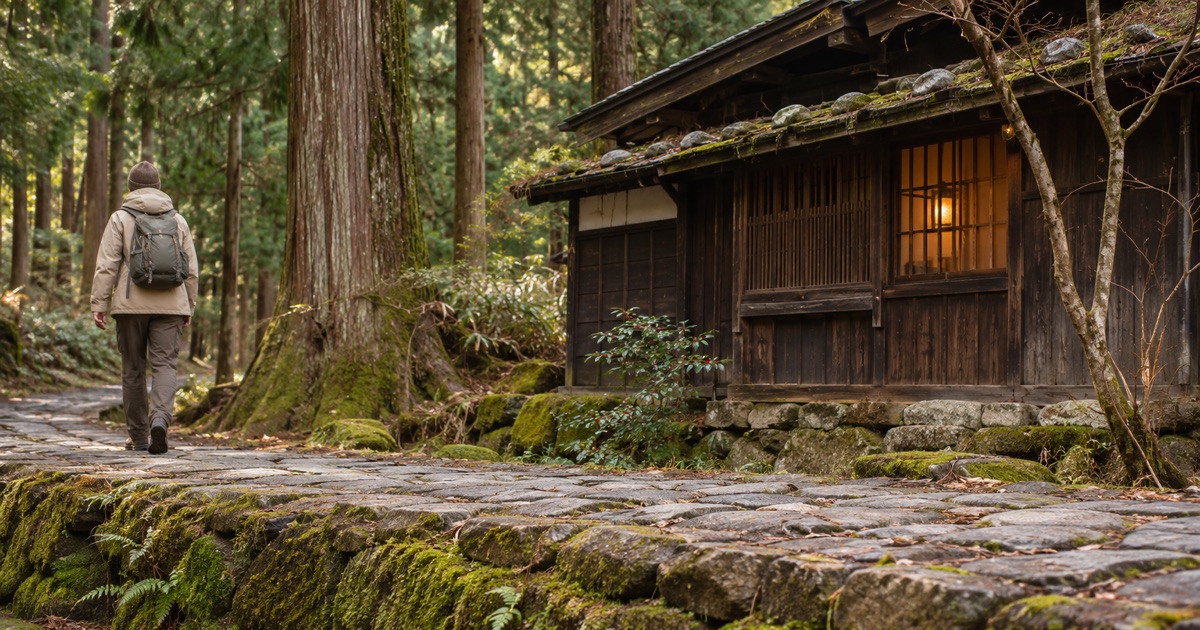
Leaving Magome behind, the path transitions from stone pavement to gravel and dirt trails flanked by tall Japanese cypress and cedar trees.
After about an hour of gradual climbing, you will reach the crest of Magome Pass. Just past the pass, you will encounter the Tateba Tea House (立場茶屋), a preserved rest stop dating back hundreds of years. Local volunteers often maintain a fire in the traditional sunken hearth (irori) and offer hot tea to passing hikers; while tea is complimentary, small donations are customary.
The trail continues downhill past the twin waterfalls of Odaki and Medaki (男滝・女滝), mentioned in historical literature and famous samurai folklore. The surrounding shaded glens make an ideal spot for a short water break.
Afternoon: Exploring Tsumago-juku
As the trail levels out, you will emerge into the quiet hamlet of O-tsumago before following a paved country lane into Tsumago-juku (妻籠宿).
Unlike Magome, which suffered fires in the early 20th century and was reconstructed, Tsumago pioneered strict preservation efforts in the late 1960s. Modern conveniences like power cables and telephone poles are buried underground, leaving the main thoroughfare looking much as it did during the Edo period.
Take time to visit the Wakihonjin Okuya (脇本陣奥谷), an official inn for high-ranking samurai, and the neighboring Tsumago Honjin (妻籠本陣). The dark-timbered buildings feature sunlight streaming through wooden lattices into traditional tatami rooms.
Late Afternoon: Onward Journey
From Tsumago, check the local bus timetable at the tourist office for departures to Nagiso Station. If you still have energy, you can walk the final 3.5 kilometers along a pleasant, mostly flat path beside the river to Nagiso Station (roughly one hour). From Nagiso, board your train back to Nagoya.
Luggage Forwarding Between Post Towns
Hiking with large suitcases or heavy backpacks is neither practical nor permitted on some local transit links. If you are traveling between Tokyo and Kyoto with luggage, consider using a commercial delivery service to send your main bags ahead to your next hotel, carrying only a small daypack on the trail.
If you have a carry-on or weekend bag with you, the local tourist information centers offer a same-day baggage forwarding service between Magome and Tsumago:
- Service Period: Generally runs from late March through late November (service is suspended during winter months).
- Drop-off: Leave your bags at the Magome Tourist Information Center in the morning (usually between 08:30 and 11:30).
- Pick-up: Collect your bags at the Tsumago Tourist Information Center in the afternoon (usually after 13:00 and before 17:00).
- Cost: Roughly 1,000 yen per piece (subject to change).
Coin lockers are also available in limited numbers at Nakatsugawa Station and Nagiso Station.
Essential Travel Tips and Preparation
Cash Is Essential
Many vendors, local buses, and small tea houses in the Kiso Valley do not accept credit cards or IC transit cards like Suica or Pasmo. Always carry sufficient Japanese yen in cash for bus fares, entrance fees, and trail snacks.
Bus Schedules Require Advance Checking
Buses between Nakatsugawa and Magome, as well as between Tsumago and Nagiso, run infrequently, often with gaps of one to two hours between departures. Obtain up-to-date timetable slips from the tourist offices or consult the Japan National Tourism Organization transport links before setting off to avoid long waits at rural bus stops.
Bear Safety
Asiatic black bears inhabit the forests of the Kiso Valley. Along the Magome to Tsumago route, you will see large brass bells mounted on wooden posts every few hundred meters. Hikers are encouraged to ring these bells firmly as they pass to alert wildlife of their presence. Bell attachments for daypacks are also widely used by local walkers.
Footwear and Weather
Mountain weather can change quickly. Even in summer, pack a lightweight waterproof jacket. In early spring and late autumn, temperatures drop sharply once the sun dips behind the ridge lines, making warm layers necessary. The historic stone paving stones can become extremely slippery during and after rain, so wear shoes with reliable tread.
FAQ
- Q. Which direction is better to hike between Magome and Tsumago?
- A. Hiking from Magome to Tsumago features less total uphill climbing, as Magome sits at a higher elevation than Tsumago, leaving only an initial ascent to the Magome Pass before a long, gentle descent.
- Q. Can I hike the Nakasendo trail as a day trip from Tokyo or Kyoto?
- A. Yes, early morning departures on the Shinkansen connecting through Nagoya Station make a round-trip hike feasible in a single day, though starting before 07:00 is recommended.
- Q. Do I need specialized hiking boots for the Magome to Tsumago walk?
- A. Sturdy walking shoes or trail runners provide sufficient support and grip for the paved cobblestones, gravel tracks, and packed earth trails along this section.
Cite or share this article
Copy the link below. If you quote this article, please link to this page as the source.